Interleaf Troubleshooting: A Field Story from the late `90s

I got to see some pretty amazing things as a Staff Consultant with Interleaf during my time there toward the tail end of last century.

On one such occasion, I was sent to a rural client in Indiana to unravel some data corruption in a customer’s Interleaf desktop publishing tool. I’m pretty sure it was a Sun-2 workstation, but I know it had an external floppy drive, the 5¼” floppy that could actually flop. Some of my more experienced colleagues had spent some time on the phone with this customer and they couldn’t figure it out, so they sent me down from our home office in Chicago with my Staff Consultant’s eyeballs, to see what I could see.

I’d been briefed about the problem—in the mornings, the customer would try to load yesterday’s saved Interleaf document from a floppy disk and most of the time the file would be corrupt, resulting in the customer needing to re-type the document.

Back then, Interleaf sold the hardware along with the software, so I’d been somewhat trained in both. In fact, following my final interview that Spring, I’d been loaned a Sun-2 workstation, mouse, keyboard, CRT, and QIC-150 drive, along with a collection of SunOS and Interleaf installation tapes, and told to start from scratch and get really good at installations. The last few weeks of college were a blur, frankly.

But by this time, I knew my way around both the hardware and the software.

I arrived at the customer site mid-morning and met my contact. It was after her first cup of coffee and after she’d already gotten started with the document. That morning she hadn’t had to re-type the document and she was getting some individual attention, so she was in a good mood, and we hit it off well. I ran some diagnostics on the hardware, confirmed that she’d recently cleaned the floppy drive heads, and made certain that both Interleaf and SunOS were up to date. She was using floppies from a reputable manufacturer and the one we were using was brand new that week.

And then I watched her like a hawk. Her every move, her every mouse click. At lunchtime, we saved the file, checked its integrity, made a backup copy for reference, opened up the file again, closed it, and then took a break for lunch.

I remember a dusty manufacturing town, but I couldn’t tell you which. I walked over to a local diner, had a sandwich, chips and a drink, then went back and we started again.

I really couldn’t see that she (or the hardware) was doing anything wrong. The Interleaf installation she was using allowed for an ASCII version of the file to be saved in addition to the standard binary format. We had kept copies of both and I’d done diffs, an octal dump, and used MD5 to validate that nothing was corrupt or drifting.

The afternoon proceeded. We got to the end of the day. Even though I was still watching her like a hawk, my engagement level had dropped off, and I had drifted back from her elbow a few feet.

She saved the file.

She shut down Interleaf.

She popped the floppy out of the drive.

She said “that’s it for the day.”

She put the floppy back into its sleeve.

She reached over her head with both hands

and slapped the floppy upside the ancient filing cabinet next to her, using a big old magnet to hold it there, along with all the other papers she kept.

“That’s it,” I nearly shouted. Nothing was wrong with the software, it was how she was storing the floppy. Magnetic media doesn’t like magnets.

So, we stayed a little later, booted up the Sun, started Interleaf and tried to load that file. Nothing. I think we even had to reformat the disk that time. Thankfully we had a backup floppy that was still on her desk, so her day wasn’t completely wasted.

I returned the next morning and we validated that the floppies on her desk were all fine. I helped her find a little cubby in a drawer where she could safely keep that collection of floppies.

And then I took my Staff Consultant’s eyeballs back home.

Posted in System Administration | Comments Off on Interleaf Troubleshooting: A Field Story from the late `90s

Not fit for print?

I am both a reader and a writer. But in recent years, I’ve struggled with both, mostly in the areas of writing about reading and writing about work.

As a reader, I’ve struggled with what to post here. Do people really want to see how my “To Be Read” stack ebbs and flows? Do people want to see how I navigate my various reading projects? Isn’t this simply more navelgazery? What’s the point?

As a writer, I’ve struggled with what to post here. So many of my unpublished articles spark from something that happened at work, i.e., “matters of professional life”. It’s quite possible to receive unwanted attention from HR in this area. We’ve seen too many times where that doesn’t end well.

And so, some time ago, I stopped posting. I continue to write (lots) and read (even more), but I generally don’t post about it. I’d like to try again someday, and I have some ideas for how to make that happen, but (as they say) we will see. I’ll most likely start by posting my Q1 2026 reading in an “Off the Shelf” post in the next couple of days.

Posted in Other Thoughts | Tagged , , , | Comments Off on Not fit for print?

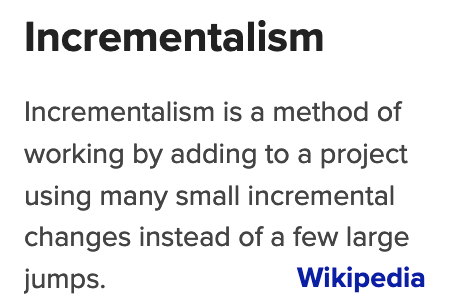
In defense of Incrementalism (in vulnerability management)

Most of the vulnerability management programs I’ve encountered suffered from analysis paralysis—the infosec team had reams of data (or multiple spreadsheets) on their vulnerabilities but couldn’t make progress because they couldn’t decide where to start.

Questions I frequently hear include:

  • What’s the biggest vulnerability (AKA high-risk)?
  • What vulnerability hits the most systems?
  • What vulnerabilities are most easily exploited?
  • What vulnerabilities impact the highest critical business system(s) the most?

Those are all excellent questions and they assume a level of maturity that an analysis paralysis-level organization hasn’t reached yet. Maybe you haven’t completed (or started) a BIA project to determine your critical business systems. Maybe you’re still working on your device inventory. Maybe you don’t know how to define “biggest” yet.

Continue reading
Posted in Cybersecurity | Tagged , | Comments Off on In defense of Incrementalism (in vulnerability management)

Off the Shelf: February 2024 (Newbery cleanup)

Newbery medal image from ALA website

Attending the ALA event at Loganberry in January to hear the Newbery awards reminded me of my goal to read all the Newbery Medals and to sample the more interesting Newbery Honors, so I loaded up February with Newberys. Many of the older ones are no longer in print and I dipped into LibriVox to listen to them.

How can I highlight notable books when everything I read this month (with two exceptions) was an award winner of some sort?

Continue reading
Posted in Other Thoughts | Tagged | Comments Off on Off the Shelf: February 2024 (Newbery cleanup)

Another post on too many meetings . . . at the wrong times

A recent post in the Journal titled “Is It Ever OK to Have an 8 a.m. Meeting?”1 got me thinking. Now, I’m not going to quote from any study or point you to some paper that backs up my habits. I’m simply going to tell you that even as an early bird and as someone who generally stays after 5pm, I won’t schedule 8am meetings. Or 4pm meetings. Or Friday meetings. And I’d rather we didn’t meet on Tuesdays, either.

Some of this comes from working a few jobs that offered flextime and thrived on Teams and Zoom. Your “first-thing Monday” might flexibly mean 9am or even 10am. And likewise, your “end of day” might well mean after I’m done washing the dinner dishes.

Continue reading
Posted in Management, Other Thoughts | Tagged , , | Comments Off on Another post on too many meetings . . . at the wrong times

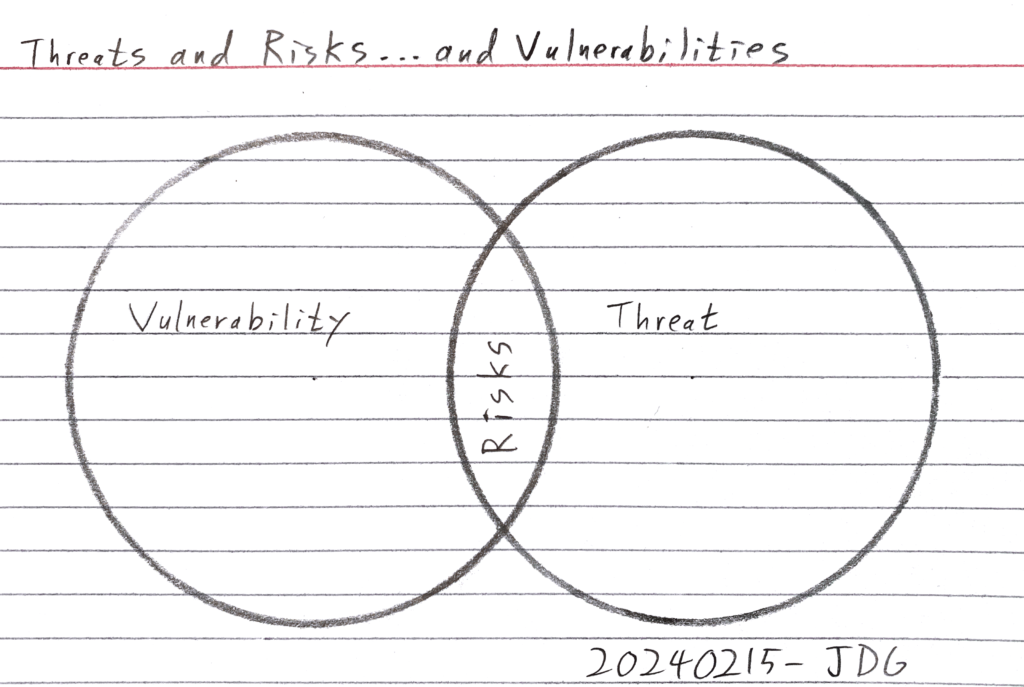
Threats and Risks . . . and Vulnerabilities

Venn diagram showing the intersection between Vulnerability and Threats as Risks
Low-tech Venn diagram showing the intersection between Vulnerabilities and Threats

During an interview last week I was asked to define the difference between a Threat and a Risk using language that a non-technical CEO would understand. I gave a good answer and made it to the next round. And then I got to thinking—in my answer, I also talked about a third factor that should have been called out: Vulnerabilities.

Let’s start with some definitions:

A vulnerability is a weakness in a system that exposes the system to a threat.
A threat is anything that could exploit a vulnerability.
A risk is the likelihood of a negative event and the likely impact.

Risks are found at the intersection between vulnerabilities and threats.

Continue reading
Posted in Cybersecurity | Tagged , , | Comments Off on Threats and Risks . . . and Vulnerabilities

Off the Shelf: January 2024

I had the opportunity to watch the ALA awards broadcast at Loganberry Books this year and that filled up my to-be-read stack, even more so than usual.

Simon Sort of Says

I went to Mac’s Backs one Saturday in late 2023 and stumbled upon local author Megan Whalen Turner posing as a bookseller. I mentioned that I try to read all of the Newbery Medal books and many of the Honor books (one of hers, The Thief, is a 1997 Newbery Honor) and so she recommended her friend Erin Bow’s Simon Sort of Says as a possible 2024 contender. Megan did a great job as a bookseller — I bought three more books than I had intended that day. And until 2024, I’d never read a Newbery before it won the award. Started in December and finished before the 15th, I can now check that goal off my list.

Simon Sort of Says is about a kid who is (for horrific reasons) internet-famous, so he and his family hide out in a fictitious National Radio Quiet Zone so he can restart his life (offline) as an ordinary seventh grader. It’s a great book and a worthy Newbery Honor.

Continue reading

Posted in Other Thoughts | Tagged , | Comments Off on Off the Shelf: January 2024

Off the Shelf: December 2023 (resiliency)

Book cover for "Adventures with a Texas Naturalist" containing a road runner and prickly-pear cactus.
Cover – Adventures with a Texas Naturalist

While meaningful to me, I don’t know that my December readings would make sense to many people. In no particular order:

Adventures with a Texas Naturalist

Bedichek is one of Texas’ great persons of letters, in the style of Thoreau. I plan on reading his Karánkaway soon and am attempting to get an affordable copy of The Sense of Smell.

Themes I took away: pay attention to what’s around you and beware of unintended consequences.

Continue reading

Posted in Other Thoughts | Tagged , , | Comments Off on Off the Shelf: December 2023 (resiliency)

Cybersecurity for Small Businesses, Part 1: Make it Harder

This is the first of six posts on Cybersecurity for small businesses. Click here for the Introduction and links to the others.


Make it Harder

Make the attacker’s job harder, starting with passwords.

Strengthen your passwords

The goal here is “easy to remember but hard to guess”, so length becomes more important than complexity. Consider passphrases rather than passwords. Pick a memorable phrase and use it (or some variation on it) or some random words as your password. (There’s even a web comic about this: https://xkcd.com/936/)

Continue reading

Posted in Cybersecurity | Tagged , , | Comments Off on Cybersecurity for Small Businesses, Part 1: Make it Harder

Cybersecurity Presentation for Small Businesses: Introduction

This series of posts started as an outline for a short presentation on Cybersecurity for small businesses that I would eventually give multiple times over a couple of years in the northeast Ohio area. At the time, I was advised to be hard on the listeners, effectively an attempt to scare them into action. I’m no longer certain that was the right approach and future versions of this presentation would rely more on persuasion and story-telling than on fear.

Continue reading

Posted in Cybersecurity | Tagged , , | Comments Off on Cybersecurity Presentation for Small Businesses: Introduction